Get a $20 World Cup Free Bet — No Deposit Required
Messi's Last Dance? The 38-Year-Old Still Hasn't Confirmed His World Cup 2026 Participation
Published: April 14, 2026
Fifty-eight days before Argentina begin their defence of the World Cup title against Algeria in Kansas City on June 16, the biggest question in world football remains unanswered: will Lionel Messi be there?
The 38-year-old Inter Miami captain — eight-time Ballon d'Or winner, 2022 World Cup champion, and holder of the record for most World Cup appearances in history — has not formally confirmed whether he will play in what would be his sixth and almost certainly final World Cup.
"It's up to him"
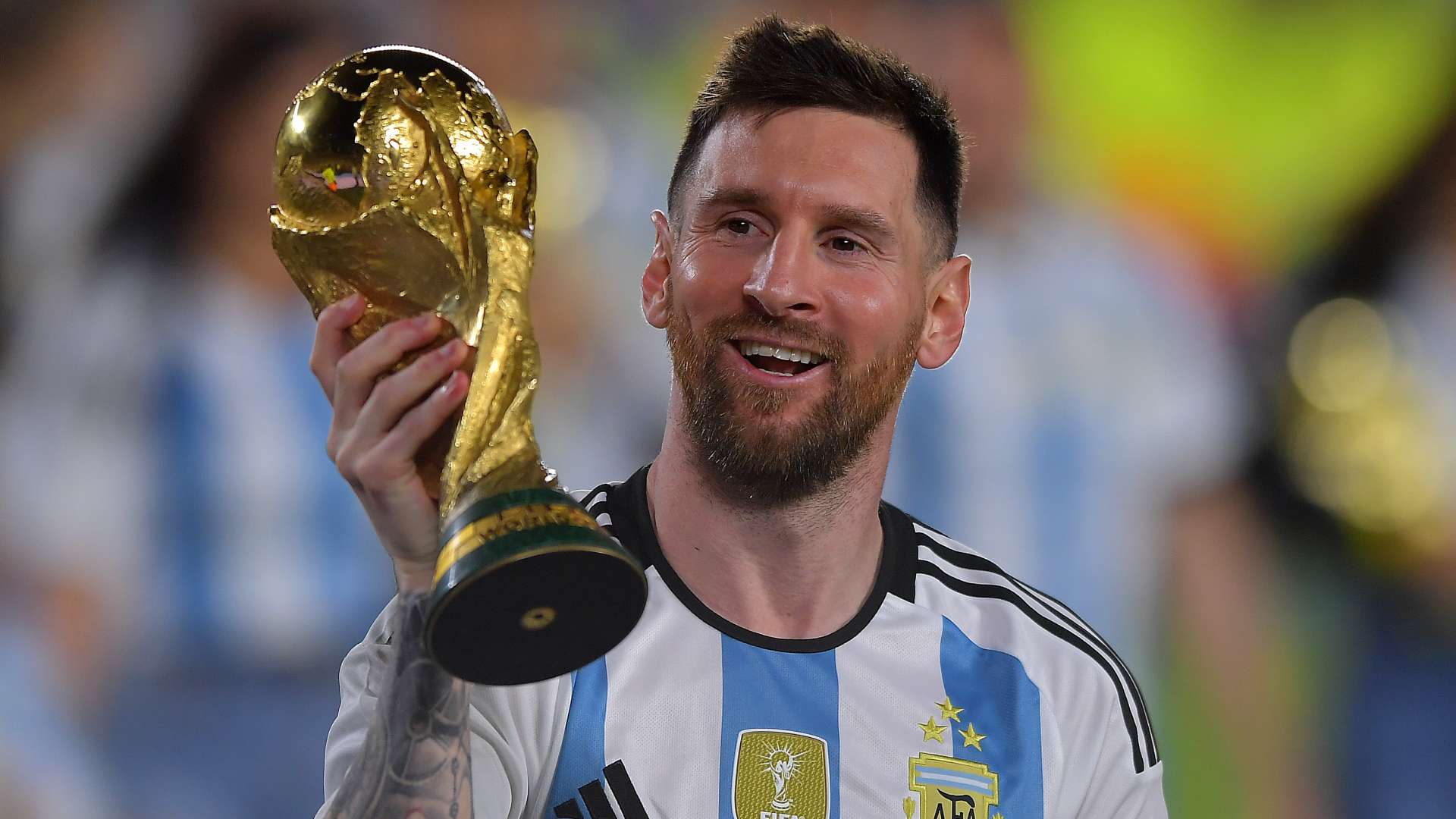
Messi lifts the World Cup trophy after Argentina's triumph in Qatar, December 2022.
Argentina head coach Lionel Scaloni addressed the subject during the March international window, where Messi was included in the squad for friendlies against Mauritania and Zambia. Messi played in both matches, scoring and assisting in a commanding 5-0 victory over Zambia — but notably did not speak to the media afterward and appeared visibly emotional in what many interpreted as a farewell to the Argentine faithful on home soil.
"I believe that he has to be there, for the sake of football," Scaloni said in a press conference. "But it's not me who decides. It's up to him, how he feels in his mind and his physical condition."
Scaloni confirmed that Messi is the only player with a guaranteed spot. "Only Messi has his place. The remaining 25 are still open," he said, while reports from Argentine media suggest that the majority of the squad is already effectively locked in.
The fitness question
At 38, Messi's body is no longer the instrument it was at 25 or even 33. He has managed recurring muscle injuries over the past two MLS seasons with Inter Miami, requiring careful load management and periodic absences from league matches. The demands of a World Cup — potentially seven matches in 30 days across multiple venues in the North American summer — represent a physical challenge of a different order.
Messi himself acknowledged the uncertainty last October. "It's something extraordinary to be able to be in a World Cup, and I would love to," he said in an interview. "I would like to be there, to be well and be an important part of helping my team, if I am there. I'm going to assess that on a day-to-day basis when I start pre-season next year with Inter and see if I can really be 100 per cent, if I can be useful and then make a decision."
The phrasing was telling. Messi did not say he would play. He said he would "see if I can be useful." For a player whose career has been defined by an almost pathological desire to perform at the highest level, the idea of attending a World Cup in diminished capacity appears to hold no appeal.
Inter Miami's schedule adds a practical complication. The club inaugurated its new 26,700-capacity stadium — the Nu Stadium at Miami Freedom Park — on April 4 against Austin FC. Messi is the commercial centrepiece of the franchise, and his presence during the early weeks of the MLS season is vital both on the pitch and for the club's business operations. Balancing those demands with the rigours of pre-tournament preparation with Argentina requires careful coordination.
Argentine media reports indicate that Messi does intend to participate in the World Cup but plans to delay the official announcement until closer to the final squad submission deadline of May 30. The delay is reportedly strategic — partly to maintain focus on his club duties, and partly because Messi wants to be certain his body can withstand the tournament before making a public commitment.
Argentina without Messi
The question of what Argentina would look like without Messi is no longer academic — it is a scenario Scaloni has been preparing for, whether he says so publicly or not.
The good news for the defending champions is that the squad is formidably talented with or without the captain. Lautaro Martínez, who was the top scorer at the 2024 Copa América and netted the winning goal in the final against Colombia, is the unquestioned starting striker. Julián Álvarez, who scored four goals at the 2022 World Cup and has since established himself as one of the most versatile forwards in European football, provides a different but equally potent attacking option.
In midfield, the core that won the World Cup in Qatar remains largely intact. Rodrigo De Paul continues to be the team's engine — all work rate, ball progression, and quiet leadership. Enzo Fernández, who won the Young Player Award at the 2022 World Cup, has matured into one of the best midfielders in the Premier League. Alexis Mac Allister adds creativity and intelligence.
Behind them, Emiliano Martínez remains one of the world's elite goalkeepers, with a penalty shootout record that borders on supernatural — he has been the decisive figure in three consecutive tournament triumphs. The defensive line, anchored by Cristian Romero and Lisandro Martínez, is experienced and battle-tested.
Emerging talent offers further depth. Giuliano Simeone, son of Atlético Madrid manager Diego Simeone, has impressed in recent squads. Real Madrid's Franco Mastantuono, despite limited club minutes, remains in contention for a squad place. Scaloni has options at every position.
And yet, the absence of Messi would be felt in ways that transcend tactical formations. His presence in the dressing room, his influence on the collective mentality of the group, his capacity to produce moments of decisive brilliance in the most pressurised situations — these are qualities that no tactical adjustment can replicate. Argentina are a better team with Messi than without him, even at 38.
The weight of history
If Messi does take the field in Kansas City on June 16, he will be attempting to join an impossibly exclusive club. Only two nations have ever won consecutive World Cups: Italy in 1934 and 1938, and Brazil in 1958 and 1962. No player has ever been the central figure in back-to-back triumphs in the modern era.
Argentina are drawn in Group J alongside Algeria, Austria, and Jordan, with matches in Kansas City and Dallas. The group is manageable, though not without risk — Algeria are stubborn opponents, Austria have improved significantly, and Jordan qualified for their first World Cup with an impressive campaign. A strong group stage finish could set up a deep run through the knockout rounds, with the possibility of a quarterfinal clash against Spain — the tournament's betting favourites — potentially in Miami, Messi's adopted home.
The symmetry is almost too neat. Messi's Inter Miami contract, his adopted city, the prospect of a World Cup knockout match in his own backyard — the narrative practically writes itself. Whether the 38-year-old's body will cooperate with the story is the only remaining variable.
The world waits
Messi's career statistics scarcely need repeating, but they bear restating for the weight they carry. He has won eight Ballons d'Or, four Champions League titles, one World Cup, and two Copa Américas. He made his senior international debut in 2005 — twenty-one years ago. He has played in five World Cups. If he plays in a sixth, he will extend a record that may never be broken.
The squad announcement is expected by May 30. The world's most famous footballer has until then to answer the question that everyone is asking and no one can answer for him.
Will Lionel Messi be at the 2026 World Cup?
The world waits. Argentina hopes. And Messi, as ever, will decide in his own time.